
Purchase ‘Roots In a Handbag’
A literary memoir of a family’s life, loves and legacy (ca 1880-1952), 900 pages, 170 illustrations, including unique photos from family archives. This book is not fiction; it is based on family stories, documents and in depth historical research. It provides unique insights into the lives of people in Vladivostok, Russia between ca. 1906 and 1922 and in Harbin, China between ca. 1905 and 1952.
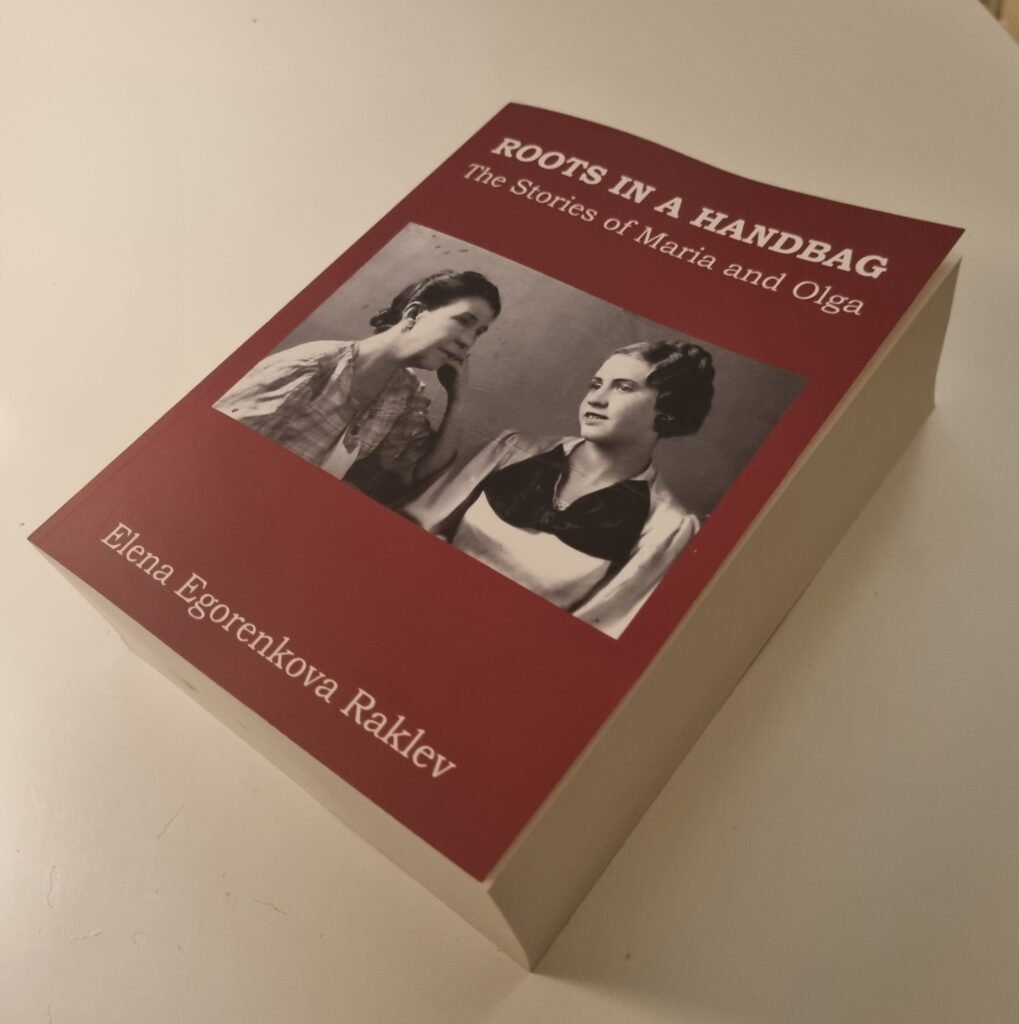
See also my videoclip where I present the book.
See what the well-known Russian Emigree newspaper “Unification” in Sydney, Australia (that exists since 1950), wrote about my book (in Russian).
Amazon Link
Find ‘Roots In a Handbag’ available for purchase on Amazon and also on Kindle as an e-book. IMPORTANT: You may occasionally see a message ‘temporarily out of stock’ on Amazon. This is standard for print‑on‑demand books such as my book and does not mean the book is unavailable.
Amazon will print and ship your copy as soon as you place your order. So just go ahead and order.
Saxo
Order your copy of ‘Roots In a Handbag’ from Saxo.
BoD Book Shop
I have self published through BoD.dk
Buy from author – Special price 300,- DKK
Send me a mail to elego@live.dk
Discover how to buy Elena’s latest book through trusted retailers. In addition to the above the book is currently available in:
Australia:
Dymocks
Denmark:
Bog & Ide
Saxo
Guccad
Imusic
William Dam Boghandel
Sweden:
Adlibris
Switzerland:
OrellFuessli
Tyskland:
exlibris
USA:
Walmart
Barnes and Noble
Praise from Readers and Fans
Discover impressions from readers who have connected deeply with ‘Roots In a Handbag – the Stories of Maria and Olga’ and its inspiring narrative.

Maria, reader from Denmark
This is the kind of book that reaches into your heart quietly and stays there. From the very first chapters, I felt an immediate connection, not only to the author’s voice, but especially to the moving, often overlooked story of Russian émigrés in China. It’s a history I knew only in fragments, but reading these pages brought it to life with such clarity, emotion, and humanity that I often had to stop just to take it in.
Even at 900 pages, the book never feels overwhelming. Instead, it feels like being invited into a living archive, one filled with resilience, longing, displacement, and the search for belonging. There were moments when I felt genuinely moved, not just by the events themselves, but by the way they’re told: gently, honestly, and with so much respect for the people whose stories shaped this narrative.
What touched me most is how the book bridges the personal and the historical. It doesn’t just recount what happened; it lets you feel the uncertainty, the courage, the small joys and the deep losses experienced by a community navigating life between cultures and continents. There were chapters that made me emotional in ways I didn’t expect.
This is not just a book you read; it’s a book you experience. You walk alongside these families, you carry their memories, and by the end, you come away changed.
For anyone interested in personal histories, migration stories, or simply beautifully written human journeys, I cannot recommend this book enough. It is heartfelt, intimate, and incredibly meaningful. A true treasure.
Goodreads, March 2026
REVIEW FROM C. LOCK, PROFESSOR (HISTORY) EMERITUS, UNIVERSITY OF COPENHAGEN
Though this work is of the length of some of the grandest Russian novels, Roots in a Handbag can be read with ease for it also has something of their pace and urgency. The eight hundred pages are filled by the reminiscences of the author’s grandmother Olga and her great-great grandmother Maria. Genealogy is decisive yet fractured, for this was a Russian family that had settled in Harbin (China) towards the end of the nineteenth century and had no trouble going back and forth before 1917.
Harbin was a city founded in Manchuria during the building of the Trans-Siberian railway and had a large Russian population. After the Revolution of 1917 that population constantly had to negotiate its survival, first during the Civil War with the generals of the White Army and soon afterwards with the new Japanese rulers of Manchukuo. During the Second World War the Russians of Harbin were torn in their loyalties, for it was the Soviets, on the side of the Allies, who represented the best protection of both Russians and Chinese from the Japanese. After the defeat of Japan in 1945 and the victory in 1949 of the Chinese Communist Party, the Russians of Harbin had little choice but to flee, though some chose to return to the Soviet Union. Many went to Australia and on to Europe or the Americas. The author’s grandparents were offered asylum in Brazil.
For those interested in the rich and chequered history of Harbin this book is simply indispensable. Both foremothers were gifted with astonishing powers of observation and with a determination that the family’s experiences should be recorded. Over a period of decades, from c 1890 to c 1950, the reader is treated to recollections, often as exquisite in their phrasing as in their observations, of details, events, procedures (so many forms to be filled!), many of which impinge on international events: the Russo-Japanese War, the two World Wars and the Russian and Chinese Civil Wars. The reminiscences of Maria and Olga are happily and authentically innocent of documentary records, and it is for readers to figure out how their memories fit with those of other Harbintsi and with historical accounts. The family photographs (published here for the first time) contribute significantly to the documentation of Harbin’s history.
The Russian emigration has its own distinguished literature of recollection, most notably Vladimir Nabokov’s Speak, Memory and Nina Berberova’s The Italics are Mine. Though by some decades a latecomer, Roots in a Handbag should be reckoned in that company. Paris, Berlin, Prague and New York form the settings of most memoirs of the Russian emigration, and Harbin is different on at least two counts: first, the “host society” was linguistically and culturally alien, and had had no place in Russian schooling; second, the Russians of Harbin were at first there on business. In these memoirs we see the city radically transformed more than once, and we see how the choice of “living abroad” was turned into the fate of exile. In witnessing these changes we witness also the continuities and varieties of “Russia abroad”.
Long as this book is, the reader is left with the hope and keen expectation of a sequel.
Harbin has long been the site of complex destinies, but none has been so amply represented as that of this family who lost everything except what could be carried in a handbag.
Charles Lock
Professor emeritus, University of Copenhagen
September, 2026
Shouka Pelaseyed, reader from Denmark
This is a must read! I was immersed into the story from the beginning. Following the lives of Maria and Olga was a fascinating journey into history and strong women. I liked the fact that the book was meticulously researched and historically correct. It really gives you not just a glimpse but a proper look into the past. There was so much that I didn’t know about Russia and post revolution times and the struggles of those who left their homeland behind. Anyone who has ever had to leave their homeland not by choice but by circumstances would really appreciate this wonderful and beautiful story. I definitely recommend this book. Looking forward to seeing the Author´s next masterpiece
Goodreads, March 2026
Nina Pokrischkin, reader from USA
A walk down memory lane. The author brought to life a beautifully written testament to family resilience. The characters are so vividly described, they felt like family in the end. Personal anecdotes and historical context are expertly described. Perfect book for fans of memoires and genealogy.
Amazon, February 2026